Friday, September 20, 2013

What is a cost variance?
#Obamacare Clark Howard did a great job answering questions about the new #health care laws

Understanding #Obamacare: Bronze, Silver, Gold and Platinum
It's less than two weeks before the state online marketplaces open for business as part of the Affordable Care Act, widely known as Obamacare. Have you decided which level of health insurance you're going to buy? Your choices are bronze, silver, gold and platinum.
As the names suggest, bronze has the cheapest premiums and, as a result, the highest out-of-pocket costs among the four plans. On the other end, platinum has the highest premiums and the lowest out-of-pocket costs for health care.
How do you decide? Money Talks News founder Stacy Johnson explains more about your choices in the following video. Check it, then read on for more details about the plans.
Thursday, September 19, 2013
What is an expense?
What HHS Didn’t Tell You about Obamacare’s “Coverage”
Newscom
This week, the Department of Health and Human Services (HHS) released a report claiming that health coverage may cost less than $100 per month for many of the uninsured. However, the HHS study left out a few key details.
First, more than half of those who will pay less than $100 per month according to HHS will do so because they will be placed into the Medicaid program.
Medicaid provides "coverage" only in the loosest sense of the term. Low reimbursements discourage many doctors from participating, and it's difficult for many beneficiaries to find someone who will accept their "coverage"—leading some to call a Medicaid card a "hunting license…a chance to go try and find a doctor." Even participants in the program have said Medicaid is not "real insurance," precisely because they can't find physicians to treat them.
Second, even those who do receive coverage on Obamacare's exchanges will receive "coverage" very similar to Medicaid—in other words, plans that offer few choices when it comes to picking a doctor. Recent reports have highlighted that insurance companies are restricting patient choices for many exchange plans, raising concerns about whether some exchange plans will have enough in-network doctors to cover their patients. Some health insurers have admitted that their exchange plans will "look a lot like the Medicaid plans that we are currently administering"—a statement that should not be reassuring to potential insurance shoppers.
There are other methodological problems with the HHS study. For instance, the report extrapolated premium numbers based on early estimates to date; it's possible that these premium rates could be unrepresentative of the country as a whole. More importantly, when it comes to HHS's definition of "coverage," and whether that health plan will provide quality care, it's caveat emptor: Buyer beware.
The post What HHS Didn't Tell You about Obamacare's "Coverage" appeared first on The Foundry: Conservative Policy News Blog from
Obamacare’s “Cadillac Tax” – A Poor Patch for a Hole in the Income Tax
The "Cadillac Tax" provision of the Affordable Care Act, which levies a 40 percent marginal tax rate on expensive employer-provided insurance, is unpopular in some circles. The Cadillac Tax is not ideal, but Cadillac plans – and other health care plans, too, for that matter – should be part of the tax base.
Health benefits are known as "in-kind" compensation. Firms give health benefits to workers in exchange for labor, just like a salary. In-kind compensation should, in general, be taxed at the same marginal rate as salary. Otherwise, firms can change your tax liability by shuffling your compensation between salary and benefits, which is silly and wasteful. The tax code's purpose is to raise revenue, not to direct the means by which people are paid for their work.
Employer-provided health insurance has historically been untaxed – a poor policy likely to encourage overspending on health insurance. While the effects of tax policy are often hard to measure empirically, there is certainly a broad consensus that Americans pay too much for their health care.
The Cadillac Tax helps equalize the treatment of health benefits and other sorts of compensation, but it is still a poor substitute for simply including health insurance in the tax base and lowering rates. As it is designed now, there is a massive spike from a zero marginal tax rate on family plans below $27,500 to 40 percent for plans above that amount.
It's as if the Obama administration is absolutely certain that the optimal amount of employer-provided health insurance for everyone - no matter what the rest of their budget looks like - is exactly $27,499. I, personally, am not so sure; some epistemological modesty from the architects of the ACA would have been welcome.
City of Cumming, Family To Fix Sediment from Lake Alice Dam Breach - Government - Cumming, GA Patch
A Republican Senator’s Lonely Mission to Make the NFL Pay Taxes
Replace Vital Documents
Unfair: Exposing the IRS
Founder of Beanie Babies to Plead Guilty to Tax Evasion
Michigan ~ Personal Income Tax: Same-Sex Couples Required to File as Single
Same-sex couples who file a joint federal income tax return must continue to file Michigan personal income tax returns using the single filing status. State law limits a joint return to a married couple who are a husband and wife. The state constitution defines marriage as the union of one man and one woman. Under state law, the phrase "husband and wife" means a man and woman who are married to each other.
Each individual who has income attributable to Michigan and who filed a joint return for federal income tax purposes as a same-sex couple must separately report adjusted gross income for Michigan as a single filer. Each individual must recalculate the federal adjusted gross income as if that person had filed a single tax return for federal income tax purposes. The Department of Treasury will provide a worksheet for the calculation.
Notice to Taxpayers: Same-Sex Couples Filing Joint Federal Income Tax Returns Must File Michigan Income Tax Returns As Single Filers, Michigan Department of Treasury, September 2013
Wednesday, September 18, 2013
How to Survive an #IRS Audit
CBO Report’s Facts Speak Louder Than Obama’s Spending and Debt Crisis Denial
The release of today's Congressional Budget Office (CBO) report on the long-term budget outlook sends one message loud and clear: The U.S. spending and debt crisis is only getting worse.
U.S. public debt doubled since before the recession and stands at a 50-year high today. The American public has not seen public debt levels this high since around World War II. While President Obama's favorite talking point on the deficit is that it "has been cut in half since 2009," he makes no mention of the real record-breaker under his term. According to the CBO:
Between 2009 and 2012, the federal government recorded the largest budget deficits relative to the size of the economy since 1946, causing federal debt to soar. Federal debt held by the public is now about 73 percent of the economy's annual output, or gross domestic product (GDP). That percentage is higher than at any point in U.S. history except a brief period around World War II, and it is twice the percentage at the end of 2007 (emphasis added).
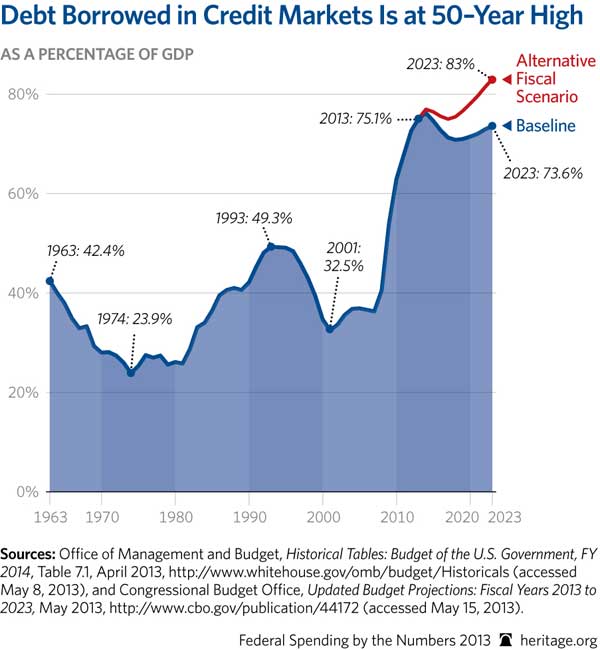
Even though there is a short-term reduction in the deficit as a percentage of GDP through 2015, this reduction is fleeting. Spending growth is projected to accelerate as Obamacare takes off and more and more baby boomers begin drawing benefits from Social Security, Medicare, and Medicaid.
Already 45 percent of all federal spending goes toward those three major entitlements, up from 25 percent a little over a decade ago. By 2023, half of all spending will be automatically directed toward these entitlements. Moreover, the cost of servicing the debt is expected to rise sharply.
The CBO lists these drivers of increasing spending over the next decade:
CBO expects interest rates to rebound in coming years from their current unusually low levels, sharply raising the government's cost of borrowing. In addition, the pressures of an aging population, rising health care costs, and an expansion of federal subsidies for health insurance would cause spending for some of the largest federal programs to increase relative to GDP.
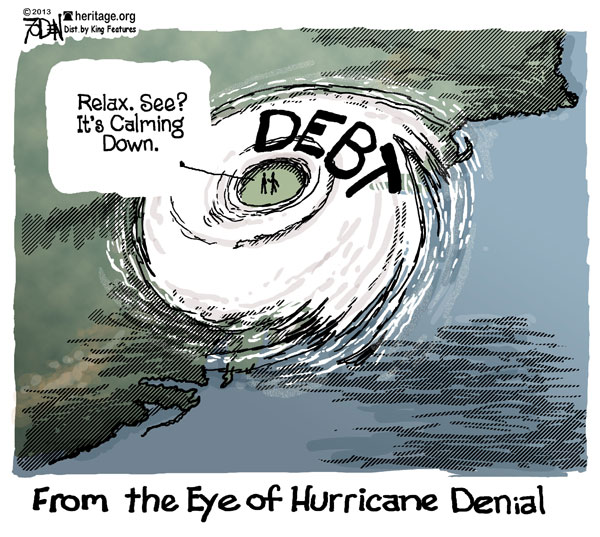
Yet President Obama doesn't seem to think that resolving the worsening spending and debt crisis is urgent at all. He has said so many times.
Before his re-election, Obama told David Letterman that "we don't have to worry about [the debt] short term."
During fiscal cliff negotiations in December, the President got annoyed with hearing about the spending crisis, and the following exchange happened with House Speaker John Boehner (R–OH):
Boehner: "Clearly we have a health-care problem, which is about to get worse with ObamaCare. But, Mr. President, we have a very serious spending problem."
Obama: "I'm getting tired of hearing you say that."
Then again, just last March, just 2 months before hitting the $16.7 trillion debt limit on May 19, President Obama repeated the sentiment on the show Good Morning America. "We don't have an immediate crisis in terms of debt."
Most recently at an August town hall event, President Obama said the same thing: "We don't have an urgent deficit crisis. The only crisis we have is the one that is manufactured in Washington and it's ideological."
Given President Obama's expressed interest in even more federal spending, it is no surprise the President has denied the urgency of the debt crisis. But for the rest of the country, CBO's facts about the budget outlook speak louder. Congress needs to cut spending and reform entitlement programs—and do so now.
The post CBO Report's Facts Speak Louder Than Obama's Spending and Debt Crisis Denial appeared first on The Foundry: Conservative Policy News Blog from The Heritage Foundation.
#Health Care Spending Crisis Coming; #Obamacare Adding Fuel to the Fire

Newscom
Today's Congressional Budget Office (CBO) report reiterates the long-standing and obvious fact that there is a health care spending crisis approaching, resulting largely from the structurally flawed Medicare program and made significantly worse by Obamacare's new unfunded entitlement spending.
The key points:
- Medicare spending is unsustainable, but it's even more unsustainable than the CBO says. The CBO report shows that Medicare spending will be 3 percent of gross domestic product (GDP) in 2013, rising to 4.9 percent of GDP by 2038. While this is a huge problem, when rational assumptions are made, the problem gets much worse. This level of Medicare spending assumes that current law will go into effect, which includes a 25 percent pay cut for Medicare physicians in January 2014 and Obamacare's over $700 billion worth of Medicare payment reductions over the next decade—both of which, if kept in place, would have a severely negative impact on seniors' ability to access care.
- Medicare has an inevitable demographic challenge that has already begun, and it is going to get much worse. The baby-boomer generation began enrolling into Medicare in 2011 at the rate of 10,000 new beneficiaries per day and will continue to do so until 2030. The number of beneficiaries will grow from about 52 million in 2013 to over 81 million in 2030. This will dramatically increase Medicare spending—a problem that has been forecasted for decades and has been ignored. Medicare needs structural reforms in order to put it on a sustainable spending path.
- Obamacare is the single biggest factor driving the growth in mandatory health care spending over the next decade. Obamacare's exchange subsidies and Medicaid expansion are projected to account for 53 percent of the increase in health care spending through 2023. This means Obamacare's spending accounts for more than even the aging population and excess health care cost growth.
Worse, as the report states, "about one-fifth of federal spending for the major health care programs in 2023 would finance care for able-bodied nonelderly people." Indeed, a vast majority of those covered by Obamacare's Medicaid expansion will be childless adults. This is in conjunction with the subsidization of coverage in Obamacare's exchanges for those earning up to 400 percent of the federal poverty level (i.e., in 2013, individuals earning up to $46,000 annually and a family of four earning up to $94,000 annually).
As the existing entitlements are still on track to bankrupt taxpayers, Obamacare's spending additions make matters far worse, to say the least.
The post Health Care Spending Crisis Coming; Obamacare Adding Fuel to the Fire appeared first on The Foundry: Conservative Policy News Blog from The Heritage Foundation.
World Economic Forum: U.S. Still Sliding
The World Economic Forum just released their global competitiveness ranking and the good news is the U.S. is still in the top 10, number 7 to be precise, just behind the Netherlands and Germany. The bad news is that's 2 places lower than last year, and 6 places lower than in 2008 when the U.S. was the most competitive economy on earth.
America's least competitive areas include taxes and government debt. The U.S. ranks 69th, right behind Ethiopia, in terms of the impact taxes have on incentives to work and invest. The U.S. ranks 103rd of 144 countries in terms of the total tax rate as a percent of profits.
U.S. respondents found taxes and government bureaucracy to be the most problematic areas for doing business:

Follow William McBride on Twitter
Tuesday, September 17, 2013
Obamacare Blamed by Seniors for High Costs, Medicare Changes - Bloomberg
Sent from Rebecca Parrott Tatum, CPA's iPhone
Taxpayers Will See Relief By Way of Inflation-Adjusted Indexing for 2014 – Wolters Kluwer, CCH Says
(RIVERWOODS, ILL., September 17, 2013) – Although slow rises in prices have been paired with only modest wage increases in many sectors of the current economy, taxpayers will at least receive some relief in 2014, thanks to the mandatory annual inflation-adjustments provided under the Tax Code, according to CCH, part of Wolters Kluwer and a leading global provider of tax, accounting and audit information, software and services (CCHGroup.com).
Today, Wolters Kluwer, CCH released estimated ranges for each 2014 tax bracket as well as projections for a growing number of inflation-sensitive tax figures, such as the personal exemption and the standard deduction.
"Indexing for inflation has become an established part of our tax system, and it's likely to be a part of the tax law for the foreseeable future – even as Congress debates changes to the tax rates themselves," said George Jones, JD, LLM and CCH Senior Federal Tax Analyst. "Most taxpayers benefit from inflation adjustments since the adjustments tend to preserve the value of most, but not all, of the dollar-based benefits under the Tax Code year after year."
The uncertainty that has previously hindered projections at this time for the past several years does not apply this fall, thanks to the American Taxpayer Relief Act of 2012 (ATRA), signed into law last on January 2, 2013. This new law permanently extended the Bush-era tax cuts and other provisions that previously hinged on Congressional action, such as the Alternative Minimum Tax (AMT) exemptions. ATRA also set forth the income thresholds for the top 39.6-percent marginal rate bracket and provided for inflation indexing for tax years after 2013.
When there is inflation, indexing of brackets lowers tax bills by including more of people's incomes in lower brackets – in the existing 15-percent bracket, for example, rather than the existing 25-percent bracket. The formula used in indexing showed a relatively higher amount of inflation this year over last, just over 1.5 percent. This increase is slightly above the 2.5 percent amount used last year and far below the 3.8 percent inflation factor used to set 2012 tax amounts. Although so-called "rounding conventions" keep some tax amounts for 2014 the same as they are for 2013, such as the $14,000 gift tax annual exclusion and the $5,500 limit on IRA contributions, most 2014 figures will move higher.
Most taxpayers will experience modest savings generated by indexing of the 2014 individual income tax rate brackets for taxpayers.
- Because of inflation adjustments, a married couple filing jointly with a total taxable income of $100,000 should pay $145 less income taxes in 2014 than they will on the same income for 2013 because of indexing of their tax bracket for 2014.
- A single filer with taxable income of $50,000 should owe $72.50 less next year due to the adjustments to the income tax rate brackets between 2013 and 2014.
Add to those savings the additional tax savings realized in most cases by slightly higher 2014 standard deduction and personal exemption amounts, as well as amounts that might be claimed from an increase in the income ceilings imposed on tax benefits such as education credits, individual retirement account (IRA) contributions and more. Combined, inflation-based tax savings for the 2014 tax year can become substantial.
Higher Taxes for Higher-income Taxpayers
New for the 2013 tax year is the 39.6 tax bracket for higher-income taxpayers, enacted by ATRA. For 2013 the bracket affects married joint filing taxpayers and surviving spouses with taxable income of $450,000 or more. The 2013 bracket begins at $425,000 for taxpayers filing as head of household. For single filers, the amount is $400,000; and for married couples filing separately, the amount is $225,000. For 2014, CCH projects that these amounts will rise to $457,600, $432,200, $406,750, and $228,800, respectively.
These inflation-adjusted amounts also trigger a 20-percent tax on that portion of taxable income attributable to net capital gains and qualified dividends that exceed these bracket amounts.
"Higher-income" taxpayers also must face two new "Medicare" taxes that started in 2013. They are the 3.8-percent surtax on net investment income and a 0.9-percent Medicare contributions tax on earned income. The net investment income tax is triggered when adjusted gross income exceeds: $250,000 (married joint filers and qualifying widowers), $200,000 (for heads of household and single filers), and $125,000 (for married single filers). The additional Medicare contributions tax is triggered when a taxpayer's wages, compensation, or self-employment income exceed these same threshold amounts. These amounts, however, are not adjusted for inflation and therefore remain the same for 2014.
Inflation Adjustments
Since the late 1980s, the U.S. Tax Code has required that federal income tax brackets be adjusted for inflation annually, and inflation adjustments have been inserted into the Internal Revenue Code in recent years with increasing frequency.
For example, the Code now requires over 50 other inflation-driven computations to determine deduction, exemption and exclusion amounts in addition to the 40 separate computations needed to inflation-adjust the tax bracket tables each year. In fact, the Patient Protection and Affordable Care Act added an even greater number of inflation-adjustments to the tax code, including figures affecting the Code Sec. 36B premium assistance tax credit, the income level under which an individual may not be penalized for failure to comply with the individual mandate, and the amount of salary reductions that can be made through a flexible spending arrangement. Some of these health-related inflation adjustments, however, have been delayed for tax years after 2014 or beyond.
Notable as one of the provisions that ATRA now requires to be permanently adjusted for annual inflation is the estate and gift tax applicable exemption. Set at a $5 million level for 2011, the amount was adjusted for inflation by Congress to $5,120,000 for 2012, $5,250,000 for 2013, and now, automatically under ATRA, to $5,340,000 for 2014. A spousal portability election can now effectively protect double that amount against estate and gift tax ($10,680,000 for 2014).
Most adjustments are based on Consumer Price Index for all urban consumers' figures for September through August immediately prior to the adjusted year. However, some inflation-adjusted figures are computed earlier and some later. For example, amounts such as the 2014 vehicle depreciation limits won't be available until later in 2013, while the standard business mileage rate (that is currently set at 56.5 cents for 2013) isn't expected to be computed for 2014 and released until December 2013.
Wolters Kluwer, CCH's projections for other indexed amounts are based on the relevant inflation data released September 17, 2013, by the U.S. Department of Labor. The IRS usually releases official numbers by December each year.
Wolters Kluwer, CCH tax bracket projections are provided for illustrative purposes only, and should not be used for income tax returns or other federal income tax related purposes until confirmed by the IRS later this year.
AMT Exemptions Indexed
Jones observed that ATRA provided for annual inflation adjustments to the exemptions from the AMT. Previously, Congress was required to explicitly increase the amounts by statute every time the so-called "AMT patch" was set to expire.
Before ATRA, Congress relied on one- or two-year AMT patches to account for inflation from the initially set amounts of $33,750 and $45,000, respectively. However, the new law provides for base exemption amounts of $78,750 for married joint filers and surviving spouses, $50,600 for single taxpayers, and $56,000 for heads of household.
Wolters Kluwer, CCH projects that for 2014, the AMT exemption for married joint filers and surviving spouses will be adjusted upward to $82,100, up from $80,800 in 2013. For unmarried single filers, the 2014 exemption will be $52,800, up from $51,900 in 2013; and for heads of household, the exemption will increase to $52,800, up from $51,900 in 2013.
Standard Deduction, Personal Exemption Rise
The standard deduction and personal exemption amounts are also subject to indexing. Projections for 2014 indicate that the trend will continue, with increases across the board. The standard deduction for single taxpayers, heads of households and married couples filing jointly will all show increases for 2014, by $100, $150 and $200, respectively.
The standard deduction for joint filers, for example, would rise from $12,200 to $12,400 in 2014. Any increase in the standard deduction, of course, can produce lower taxes by decreasing the taxpayer's taxable income.
The additional standard deduction for those age 65 or older or who are blind will stay at its present $1,200 level in 2014 for married individuals and surviving spouses because of "rounding down," but will increase to and at $1,550 for single aged 65 or older or blind filers. The personal exemption amount gets bumped up by inflation by $50, to $3,950 in 2014 after having increased $100 between 2012 and 2013.
Taxpayers for many years have had to lose a good portion of the value of personal exemptions and itemized deductions when their incomes rise above certain levels, which have also been adjusted for inflation. Starting in 2010, these "phase-outs" disappeared from the tax code, but ATRA reintroduced them in 2013 for certain higher-income taxpayers. ATRA set forth base amounts for the phase out ranges, which represented increases from their pre-2010 levels, even before inflation-adjustments.
The 2014 phase out range for personal exemptions begins at $305,050 for joint filers and $254,200 for single filers. The same income ranges apply to the phase-out of itemized deductions.
"Bringing back the reduction in itemized deductions and personal exemptions for higher-income individuals exposes more income to the higher 39.6 percent rate, therefore compounding bottom-line tax liability for this group. The projected inflation-factor that cuts back on this reduction for 2014 from 2013 levels helps, if only just a bit," Jones said.
For a complete look at how income ranges for each tax bracket are projected to shift next, see the Wolters Kluwer, CCH tables below.
"Kiddie" Deduction, Gift Tax Exemption
In general, inflation adjustments are rounded to the next-lower multiple of $50, so if the adjustment produces an increase of less than $50, no increase is made. The "kiddie" deduction, used on the returns of children claimed as dependents on their parents' returns, increased only six times in the years 2001 through 2013. It last rose for the 2013 tax year. For 2014 the deduction will remain at that $1,000 level.
The Code only allows the gift tax exemption to rise when the inflation adjustment would produce an increase of $1,000 or more. The last increase occurred in 2013, when it rose to $14,000. It remains there for 2014.
About CCH, a part of Wolters Kluwer
CCH, a part of Wolters Kluwer (CCHGroup.com) is a leading global provider of tax, accounting and audit information, software and services. It has served tax, accounting and business professionals since 1913. Among its market-leading solutions are The ProSystem fx® Suite, CCH Axcess™, CCH® IntelliConnect®, Accounting Research Manager® and the U.S. Master Tax Guide®. CCH is based in Riverwoods, Ill. Follow us on Twitter @CCHMediaHelp. Wolters Kluwer (www.wolterskluwer.com) is a market-leading global information services company. Wolters Kluwer is headquartered in Alphen aan den Rijn, the Netherlands. Its shares are quoted on Euronext Amsterdam (WKL) and are included in the AEX and Euronext 100 indices.
Wolters Kluwer, CCH 2014 Tax Projections*
Married Filing Jointly (& Surviving Spouse)
| Tax Rate | 2014 Taxable Income | 2013 Taxable Income |
| 10% | $0–$18,150 | $0–$17,850 |
| 15% | $18,150–$73,800 | $17,850–$72,500 |
| 25% | $73,800–$148,850 | $72,500–$146,400 |
| 28% | $148,850–$226,850 | $146,400–$223,050 |
| 33% | $226,850–$405,100 | $223,050–$398,350 |
| 35% | $405,100–$457,600 | $398,350–$450,000 |
| 39.6% | $457,600+ | $450,000+ |
Unmarried Individuals (Other Than Surviving Spouses and Heads of Households)
| Tax Rate | 2014 Taxable Income | 2013 Taxable Income |
| 10% | $0–$9,075 | $0–$8,925 |
| 15% | $9,075–$36,900 | $8,925–$36,250 |
| 25% | $36,900–$89,350 | $36,250–$87,850 |
| 28% | $89,350–$186,350 | $87,850–$183,250 |
| 33% | $186,350–$405,100 | $183,250–$398,350 |
| 35% | $405,100–$406,750 | $398,350–$400,000 |
| 39.6% | $406,750+ | $400,000+ |
Head of Household
| Tax Rate | 2014 Taxable Income | 2013 Taxable Income |
| 10% | $0–$12,950 | $0–$12,750 |
| 15% | $12,950–$49,400 | $12,750–$48,600 |
| 25% | $49,400–$127,550 | $48,600–$125,450 |
| 28% | $127,550–$206,600 | $125,450–$203,150 |
| 33% | $206,600–$405,100 | $203,150–$398,350 |
| 35% | $405,100–$432,200 | $398,350–$425,000 |
| 39.6% | $432,200+ | $425,000+ |
Married Individuals Filing Separate Returns
| Tax Rate | 2014 Taxable Income | 2013 Taxable Income |
| 10% | $0–$9,075 | $0–$8,925 |
| 15% | $9,075–$36,900 | $8,925–$36,250 |
| 25% | $36,900–$74,425 | $36,250–-$73,200 |
| 28% | $74,425–$113,425 | $73,200–$111,525 |
| 33% | $113,425–$202,550 | $111,525–$199,175 |
| 35% | $202,550–$228,800 | $199,175–$225,000 |
| 39.6% | $228,800 | $225,000+ |
Standard Deduction Amounts
| Filing Status | 2014 | 2013 | Increase |
| Married Filing Jointly (& Surviving Spouse) | $12,400 | $12,200 | $200 |
| Married Filing Separately | $6,200 | $6,100 | $100 |
| Single | $6,200 | $6,100 | $100 |
| Head of Household | $9,100 | $8,950 | $150 |
Standard Deduction for Dependents ("Kiddie" Standard Deduction)
| 2014 | 2013 | Increase |
| $1,000 | $1,000 | $0 |
Personal Exemption Amounts
| 2014 | 2013 | Increase |
| $3,950 | $3,900 | $50 |
Gift Tax Exclusion
| 2014 | 2013 | Increase |
| $14,000 | $14,000 | $0 |
* These numbers are projected for the 2014 tax year and have not been confirmed by the Internal Revenue Service.
ACA Information to be Reported by Businesses

Affordable Care Act Update
If your business is covered by the Fair Labor Standards Act (generally, those businesses that have at least one employee and at least $500,000 in annual sales), you must notify your full-time and part-time employees by October 1, 2013, of their options for complying with the new healthcare law.All new employees hired after October 1, 2013, must be notified on the date of their hire.
The Department of Labor has created two sample notices. These may be used to communicate with your employees.
Read more...
U.S. Treasury Secretary Lew Warns Against Tying Health-Care Law Funding To Debt Ceiling -- Update
Tax penalties for individuals, companies who opt out of health reform law - Baltimore Sun
New procedures for equitable innocent spouse relief are released
Failure to Fund Government Would Create “Massive Economic Turmoil,” President Says
President Obama warned House Republicans on September 16 that the current stand-off over the federal budget, due to expire at the end of September, would create economic havoc and reverse the progress achieved to this point in pulling the country out of its economic malaise. The president specifically directed his remarks at a group of House Republicans who are promising to shut down the government at the end of the month if they are unable to withhold funding for the Patient Protection and Affordable Care Act (PPACA) (P.L. 111-148).
"We've cleared away the rubble from the financial crisis and we've begun to lay a new foundation for economic growth and prosperity," said Obama during a press conference marking the five-year anniversary of the financial crisis. "Let's stop the threats. Let's stop the political posturing. Let's keep our government open. Let's pay our bills on time. Let's pass a budget."
House Speaker John Boehner, R-Ohio is in the middle of a revolt among some 50 House members. Disagreements within the House Republican caucus over legislation that would temporarily fund the federal government and force the Senate to vote on defunding the PPACA have led to legislative gridlock. Republican leaders on September 11 found themselves short of votes and were forced to pull from consideration on the House floor a continuing resolution bill that would have kept the federal government operating for the first three months of the new fiscal year beginning on October 1 (TAXDAY, 2013/09/12, C.1).
Faced with a restive caucus, Boehner released a statement accusing Obama of playing partisan politics in his speech and called on the president to work with Republicans "to delay his health care law for everyone—just as he's done for big businesses—expand energy production, simplify our tax code and more."
Obama defended his health care law, claiming that there is no real evidence that the PPACA is holding back economic growth. "I will never convince some Republicans about the merits of "Obamacare." I understand that. And, I'm more than willing to work with them where they've got specific suggestions that they can show will make our health care system work better," said the president. "Repealing the Affordable Care Act, making sure that 30-million people don't get health insurance and people with pre-existing conditions continue to be locked out of the health insurance market, that's not an agenda for economic growth," said Obama.
The president also chided Republicans on the issue of tax reform, saying that they have yet to put out any realistic ideas for fixing the tax code after saying less than three months ago that tax reform was one of their top priorities. "I put forward a plan that serious people in both parties should be able to support: a deal that lowers the corporate tax rate for businesses and manufacturers. Haven't heard back from them yet," said the president.
By Jeff Carlson, CCH News Staff
Updated Guidance Provided for Taxpayers Seeking Equitable Innocent Spouse Relief from Tax Liabilities (Rev. Proc. 2013-34)
the threshold requirements for any request for equitable relief;
the conditions under which the IRS will make streamlined relief determinations granting equitable relief under Code Sec. 6015(f) from an understatement of income tax or an underpayment of income tax reported on a joint return, or the operation of community property law under Code Sec. 66(c) ; and
a nonexclusive list of factors for consideration in determining whether relief should be granted under Code Sec. 6015(f) because it would be inequitable to hold a requesting spouse jointly and severally liable when the conditions for streamlined relief are not met (these factors also will apply in determining whether to relieve a spouse from income tax liability resulting from the operation of community property law under the equitable relief provision of Code Sec. 66(c)).
The new procedure is effective for requests for relief filed on or after September 16, 2013. In addition, the procedure is effective for requests for equitable relief pending on September 16, 2013, whether with the Service or in a case docketed with a federal court. Rev. Proc. 2003-61, 2003-2 CB 296, is superseded.
Rev. Proc. 2013-34, 2013FED ¶46,517
Other References:
Code Sec. 66
CCH Reference – 2013FED ¶6051.075
CCH Reference – 2013FED ¶6051.20
Code Sec. 6015
CCH Reference – 2013FED ¶35,192.01
CCH Reference – 2013FED ¶35,192.023
CCH Reference – 2013FED ¶35,192.25
Tax Research Consultant
CCH Reference – TRC INDIV: 18,052.30
CCH Reference – TRC INDIV: 18,058
CCH Reference – TRC INDIV: 18,058.05
CCH Reference – TRC INDIV: 18,058.10
CCH Reference – TRC INDIV: 18,058.15
CCH Reference – TRC INDIV: 18,060
CCH Reference – TRC INDIV: 24,154
CCH Reference – TRC INDIV: 24,154.15
15% of Americans live in poverty
Monday, September 16, 2013
Uncle Sam collects $284 billion more in taxes so far in 2013
 The U.S. Treasury picked up $284 billion in August. That added revenue, according to the Congressional Budget Office (CBO), means Uncle Sam's budget deficit at the end of last month was $411 billion smaller than at the comparable period last year.
 That sizable reduction, making the budget deficit around $753 billion for the first 11 months of the 2013 fiscal year, is noteworthy.
At this point in 2012, the budget deficit was $1.164 trillion. The previous low budget deficit was $1.23 trillion in 2011, while the high was $1.89 trillion in 2009, according to Treasury Department data.
Even the CBO is a tad surprised at the shrinkage (insert your own Seinfeld-inspired joke here), noting in its blog that "the federal budget deficit has fallen faster than we expected a few years ago."

Source: CBO Monthly Budget Review for August 2013
Money, money, money: But I'm a tax geek, meaning I tend to focus on revenue. So the $284 billion in collections recorded by the CBO is this week's By the Numbers figure.
Just where did the money come from?
The biggest chunk came from individual income and payroll taxes. Together those collections increased 14 percent, or by $251 billion.
Payroll taxes withheld from workers' paychecks rose by $160 billion, or 10 percent, primarily because the 2 percentage point payroll tax cut expired at the end of 2012. Effective this January, the full 6.2 percent portion of FICA again started coming out of workers' pay.
As for income taxes, January also marked the appearance of higher tax rates for some folks earning larger amounts.
Taxes that weren't withheld: Other taxes that weren't withheld also added to Uncle Sam's bottom line. This category of taxes increased by 27 percent, or by $91 billion.
Most of these nonwithheld taxes were the 2012 annual Form 1040 (and 1040A and 1040EZ) filings submitted between February through April. Those payments, says the CBO, were much larger than 2012's amounts.
Part of the tax money during this period also came from increased estimated payments, made in the spring and summer for the current tax year. Remember, you can continue to do your part toward budget deficit reduction by sending in your third estimated tax amount for 2013 that's due Monday, Sept. 16.
Corporate tax contributions: Companies contributed, too. The CBO says that net corporate income taxes during this period were higher by $30 billion, or 16 percent.
The budget analysts surmise this is likely because of growth in taxable profits in calendar year 2012 and the first half of calendar year 2013.
These numbers should give the House and Senate some maneuverability in their upcoming fiscal 2014 budget wrangling.
Still, don't expect the process to be easy or quick.
Conventional wisdom is that Congress will pass a stopgap spending bill, possibly as soon as next week, to keep spending at current levels for two to three months while lawmakers hammer out a final budget deal.
Of course, there's not been much that's been conventional about this current Congress.
You also might find these items of interest:
More States Lower Taxes
Clean up the IRS: Column
Sunday, September 15, 2013
WSJ: IRS Challenges Tax-Exempt Status of Schools' Booster Clubs
Some Smartphones Worth $300 in Walmart’s Trade-In Program
Walmart will begin offering store credit toward new smartphones for trade-ins on Sept. 21.
More than 100 models will be accepted for somewhere between $50 (a Samsung Galaxy S2) and $300 (an iPhone 5) in credit, it says. The full list of phones and their values isn't online yet, although ads for the program say it will appear at www.walmart.com/tradeineligibility.
To participate, bring the phone to a Walmart or Sam's Club electronics department. An associate will ask questions about the device's condition and specifications. The phone must be "in working condition without having a cracked or broken screen or housing or any sign of liquid damage."
Repair regulations are finally issued
Friday, September 13, 2013
Louie Gohmert Blasts Obama Administration, IRS: Defunding The Executive Branch May Be Necessary
How to Estimate Your Social Security Benefits
Whether you're getting close to retirement or planning for the future, you can estimate your Social Security benefits.
The estimator gives you an idea of what your monthly Social Security benefits would be, based on your current record of Social Security earnings. Your actual benefit amount cannot be determined until you apply for benefits.
As you plan for your retirement, keep in mind that you'll need 70-90 percent of your pre-retirement earnings to maintain your standard of living when you stop working. Social Security benefits will only make up a part of this percentage and should be supplemented by a pension, savings, and/or investments. Check out 10 Ways to Prepare for Retirement.
An App For Social Change, Hot Mess Anonymously Tells Your Friends That They Have Gunk In Their Teeth

Neil Mansilla and Rob Zazueta got a lot of laughs this afternoon for their Disrupt Hackathon submission, Hot Mess. The app aims to solve the universal nightmare of unwittingly walking around with a piece of crud in your teeth by allowing people to send anonymous texts alerting you to the situation.
Users can choose from a variety of common scenarios, like "eye boogers", "nose nuggets", "teeth gunk", and "dragon breath". (Their phrasing.) Hot Mess sends a discreet text message letting a person know that "An angel has sent you a hint" and that they should read it in a private place. The text includes a link to a description of the problem accompanied by a very flattering photo of Zazueta demonstrating the issue.
Zazueta clarified that he created the images using gum for nose goop, Red Vines for tooth gunk, and cake as an eye booger.
Importantly, all messages and images are pre-programmed so that users can't use it to bully others and keep Hot Mess helpful and positive. The presentation got the audience laughing — who hasn't walked around with their fly unzipped at some point? — but as the team explained, the hack is meant to serve a broader social purpose.
"This is intended to break a social taboo," Mansilla said backstage. "If someone is a close talker and has halitosis, or is too loud, it's hard to share that without offending them. Why? You're doing them a disservice by not telling them."
The goal is that apps like Hot Mess will make themselves obsolete by creating a social climate in which people are happy to tell each other to go blow their nose.
The app would be particularly useful in professional situations, Zazueta and Mansilla said, where looking like a slob seriously affects people's perception of you and co-workers might not feel comfortable making a comment.
"The giver gets good karma and the recipient won't feel bad because they think the intent is genuine. I think everyone can completely relate to this, which is why it was funny."
Mansilla and Zazueta said that they were interested in building other verticals for Hot Mess, like sending a message to someone in a bar when they're hitting on someone too hard or need to talk less. Another potential feature is time delay between sending and receiving the message, which would help protect the sender's anonymity and could be especially helpful for chronic problems that don't require a quick fix.
It's like on the subway. If you see something, say something.
House Passes Bill to Restrict Affordable Care Act Subsidies
"We must protect taxpayer dollars to ensure that only those who are entitled to subsidies receive them, and this legislation corrects a serious error on the administration's part," said Ways and Means Committee Chairman Dave Camp, R-Mich. He urged the Senate to take up the legislation, but swift action appears unlikely, especially since the President Obama has promised to veto the measure.
House Democrats said the floor action was the 41st time that GOP lawmakers have voted to either repeal or defund the PPACA. House Minority Whip Steny H. Hoyer, D-Md., said HHS safeguards are already in place. "A system to verify the income of applicants for these credits and subsidies is already in place along with a system to verify that, at the end of each year, no American received more or less than the law allows," Hoyer said.
By Stephen K. Cooper, CCH News Staff